


Sowmyanarayana Perumal Temple
Syllabus: GS1/ Culture
Context
- PM Modi met priests from the Sowmyanarayana Perumal Temple.
About
- Location: Thirukoshtiyur, Sivagangai district, Tamil Nadu.
- Religious Significance: The temple is one of the 108 Divya Desams, the most sacred Vaishnavite shrines dedicated to Lord Vishnu.
- It holds a revered position in the history of Vaishnavism.
- Historical Significance: This is the sacred place where Shri Ramanujam revealed the Naraayana Mantra to the public, contrary to his guru’s instructions, to help people achieve salvation.
Architectural Features
- The temple is built in the Chola architectural style.
- It has a unique three-tier sanctum, representing different postures of Lord Vishnu;
- Ground level: Lord Krishna in a dancing form.
- First level: Vishnu in Sayana (reclining) posture.
- Top level: Vishnu in standing posture.
- The shrine is crowned by the rare Ashtanga Vimana. Only a few Vishnu temples in India possess this distinctive vimana.
Source: PIB
Granth Kutir
Syllabus: GS1/Culture
Context
- The President of India inaugurated Granth Kutir.
About
- Granth Kutir is a library at the Rashtrapati Bhawan which has the collection of around 2,300 books and about 50 manuscripts in 11 Indian classical languages: Tamil, Sanskrit, Kannada, Telugu, Malayalam, Odia, Marathi, Pali, Prakrit, Assamese, and Bengali.
- The collection reflects India’s cultural, philosophical, literary, and intellectual heritage.
- Subjects include epics, philosophy, linguistics, history, governance, science, devotional literature, and the Constitution of India in classical languages.
- Several manuscripts are handwritten on traditional materials such as palm leaf, paper, bark, and cloth.
- Granth Kutir supports the vision of the Gyan Bharatam Mission, which aims to preserve, digitise, and disseminate India’s manuscript heritage, blending tradition with modern technology.
Institutional Support
- It is developed through collaboration with central and state governments, universities, research institutions, cultural organisations, and individual contributors.
- Supported by the Ministry of Education and Ministry of Culture.
- The Indira Gandhi National Centre for the Arts (IGNCA) provides expertise in manuscript conservation, documentation, management, and display.
Source: PIB
Netaji Subhas Chandra Bose
Syllabus: GS1/History
Context
- The President of India, paid tribute to Netaji Subhas Chandra Bose on his birth anniversary, observed as Parakram Diwas.
About Netaji Subhash Chandra Bose
- He was a prominent Indian nationalist and leader who played a crucial role in the Indian independence movement.
- He was the first person to call Mahatma Gandhi “Father of the Nation”, in his address from Singapore.
- Indian National Congress:
- He was elected as the President of the Indian National Congress twice, in 1938 and 1939.
- Ideological differences with Mahatma Gandhi led to his resignation and the formation of the Forward Bloc, a political faction committed to radical change.
- Azad Hind Radio 1942: He established Azad Hind Radio in Germany to reach out to Indians and spread his vision of independence.
- He coined several patriotic slogans, including “Jai Hind,” “Dilli Chalo” (On to Delhi), and “Give me blood, and I will give you freedom”.
- Formation of Indian National Army (INA): In 1942, he formed the INA with the help of Japanese forces.
- The INA was an armed force aimed at securing India’s independence through military action against British rule.
- Azad Hind Government: In 1943, Subhash Chandra Bose renamed the Andaman and Nicobar Islands as “Shaheed” (Martyr) and “Swaraj” (Self-Rule) during his leadership of the Azad Hind Government.
- This was a symbolic gesture of asserting India’s sovereignty against British rule.
- On October 21, 1943, Netaji declared the establishment of the Provisional Government of Free India (Azad Hind Sarkar).
- Subhash Chandra Bose reportedly passed away in a plane crash in Taiwan in 1945.
- Legacy: Ross Island (an island of the Andaman Islands) was renamed Netaji Subhas Chandra Bose Dweep in 2018 in his honour.
- The Kranti Mandir Museum at the Red Fort preserves key historical material related to Netaji Bose and the Indian National Army.
- In 2022, a grand statue of Netaji Subhas Chandra Bose was unveiled by the Prime Minister near India Gate, New Delhi.
Source: PIB
Vande Mataram and the Debate on National Honour
Syllabus: GS1/History; GS2/ Polity and Governance
Context
- The Union Ministry of Home Affairs is examining whether Vande Mataram should be governed by formal protocols and attract penalties for disrespect, on lines similar to the national anthem Jana Gana Mana.
About
- The Constituent Assembly accorded Vande Mataram the status of the national song, with equal honour to the national anthem, but not identical legal treatment.
- Prevention of Insults to National Honour Act, 1971: Provides statutory protection to the National Flag and the National Anthem.
- No penal provision exists for disrespect to Vande Mataram under the Act.
Constitutional Provisions
- Article 51A(a) Fundamental Duties: Mandates every citizen to abide by the Constitution and respect its ideals and institutions, the National Flag and the National Anthem.
- Absence of Explicit Constitutional Protection: Unlike the national anthem, Vande Mataram is not explicitly protected by any constitutional provision.
- Its status flows from Constituent Assembly resolutions, not from enforceable constitutional text.
| Vande Mataram – Vande Mataram was composed by Bankim Chandra Chatterjee in Sanskrit and first appeared in the novel Anandamath in 1882. a. Anandamath is set against the backdrop of the 1769–73 Bengal famine and the Sanyasi Rebellion. – First sung by Rabindranath Tagore at the 1896 Indian National Congress session gave it national exposure. – During the Swadeshi Movement of 1905, Vande Mataram emerged as the anthem of civil resistance. a. Vande Mataram, as a political slogan, was first used on 7 August 1905. – National Song: On 24 January 1950, the first two stanzas were adopted as India’s National Song. |
Source: IE
Donbas
Syllabus: GS1/Places in News; GS2/IR
Context
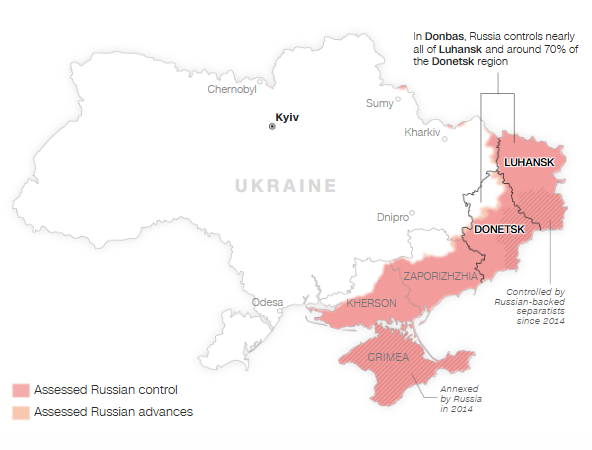
- As the United States, Russia and Ukraine met in Abu Dhabi for peace talks, Russia and Ukraine remain sharply divided over the future of Donetsk.
Donetsk
- Donetsk is one of four Ukrainian regions Russia claimed to annex in 2022 after disputed referendums.
- Ukraine, Western countries, and most of the world recognise Donetsk as part of Ukraine.
- Russia claims Donetsk as part of its “historical lands.”
Donbas
- Collectively known as the Donbas, the two coal-rich eastern Ukrainian regions of Donetsk and Luhansk used to be Ukraine’s industrial heartland.
- The region is well connected to the Sea of Azov by rivers and man-made canals. It is also known for its fertile agricultural ground and rich mineral deposits.
- Russian troops control almost all of the Luhansk region, they’ve only managed to seize 70% of Donetsk.
- Legality: Under Ukraine’s constitution, territorial changes must be settled by a referendum that can be called if it has the signatures of 3 million eligible Ukrainian voters in at least two-thirds of Ukraine’s regions.
Source: IE
Franz Edelman Award
Syllabus: GS2/Governance
Context
- The Department of Food and Public Distribution (DFPD) is among the six finalists for the prestigious 2026 Franz Edelman Award for its Anna Chakra initiative.
Anna Chakra initiative
- Anna Chakra is an operations research (O.R.) based decision support solution that strengthens India’s Public Distribution System by optimizing state-specific logistics.
- It is developed in partnership with the United Nations World Food Programme (WFP) in India and the IIT, Delhi.
- It was launched in 2025 to strengthen the movement of food grains across India. Its national deployment has generated:
- Estimated annual savings of INR 250 crore.
- A 35% reduction in emissions, supporting India’s climate commitments.
- Efficiency gains that benefit more than 81 Crore PDS beneficiaries, including the most vulnerable populations.
Franz Edelman Award
- It is the world’s most prestigious award in the field of Operations Research (OR) and advanced analytics.
- It is widely known as the “Nobel Prize of Operations Research and Analytics.”
- Instituted by: INFORMS (Institute for Operations Research and the Management Sciences) a global professional body for analytics and OR.
- It is named after Franz Edelman, a pioneer in management science and operations research.
- The award recognizes the real-world, high-impact applications of operations research, advanced analytics, mathematical modeling and data-driven decision-making.
Source: PIB
Uttar Pradesh Statehood Day
Syllabus: GS2/Polity
Context
- The Prime Minister extended greetings to the people of Uttar Pradesh on the occasion of the state’s Establishment Day.
About
- During the colonial period the region was called the United Provinces of Agra and Oudh.
- The name was shortened to the United Provinces in 1935.
- On January 24, 1950 the United Provinces was renamed as Uttar Pradesh.
- The State is bound by Uttarakhand and Himachal Pradesh in the north, Haryana in the west, Madhya Pradesh in the South and Bihar in the east.
- It has an international border with Nepal.
- It is the most populous and 4th largest state of India.
- It is recognized as the “Sugar Bowl of India” because it is the country’s largest producer of sugarcane.
- Major rivers: Ganga, Yamuna, Ghaghara, Gomti, Rapti, Son, Betwa, Ken.
Source: PIB
SEBI Flags Insider Trading Lapses in Yes Bank Share Sale
Syllabus: GS3/ Economy
Context
- The Securities and Exchange Board of India (SEBI) has accused executives from PwC and EY, among others, of breaching insider trading rules involving a 2022 share sale by Yes Bank.
What is Insider Trading?
- Insider trading refers to the practice of purchasing or selling a publicly-traded company’s securities while in possession of material information that is not yet public information.
- Material information refers to any and all information that may result in a substantial impact on the decision of an investor regarding whether to buy or sell the security.
- It is prohibited under the SEBI (Prohibition of Insider Trading) Regulations, 2015.
Impact of Insider Trading
- Financial Markets:
- Distorts fair price discovery mechanism.
- Creates an uneven playing field between informed insiders and ordinary investors.
- Impact on Investors:
- Small and retail investors suffer losses due to information asymmetry.
- Reduces confidence in the integrity of capital markets.
Source: TH
Prakash Ganga Tableau
Syllabus: GS3/ Energy
Context
- The Ministry of Power will showcase a tableau titled “Prakash Ganga: Powering an Aatmanirbhar and Viksit Bharat” at the Republic Day Parade of 2026.
About
- The tableau traces India’s journey from achieving universal electricity access to emerging as a global clean energy player.
- The theme Prakash Ganga – meaning “River of Light” – symbolises the seamless and continuous flow of power across the interconnected national grid.
Key features of the Tableau
- A robotic Smart Meter model, accompanied by wind turbine generators, reflecting the integration of digital technologies, automation, and smart solutions for efficient power management.
- The central section depicts the “Smart Power, Smarter Home” concept with rooftop solar installations.
- A towering transmission structure represents last-mile connectivity, while an EV charging station and electric scooter demonstrate the power sector’s role in enabling clean mobility and a sustainable transport ecosystem.

Source: PIB
Previous article
One District One Product (ODOP)
